Friday, August 17, 2012

Schwarzenegger: An Action Retrospective

This past July, Arnold Schwarzenegger turned 65. The man has lived an interesting life, to say the least. There’s the old cliché of immigrants coming to America and making something of themselves, but how many have gone on to achieve the success he has had in bodybuilding, movie, or politics, let alone all three? He is the American Dream, pumped up to the highest level.

Though he first gained exposure as a bodybuilder, and served as Governor of California, his greatest legacy—to me and I’m sure to most people—was and is being an action hero. And now that his tenure as governor is over, he’s making an action movie comeback, starting this weekend with a major role in The Expendables 2. To celebrate his return to what made him an icon in the first place, here’s a look back at his career as an action star, from the highs to the lows.

Classics


The Terminator (1984) and Terminator 2: Judgment Day (1991)
Easily his most recognizable role, the old T-800 cyborg from the future is arguably still his best. Supposedly, O.J. Simpson was considered for the role. Thank God that didn’t come together, because for all the picture’s merits (a cool story, good action sequences for a low-budget film), it would not be the same without Arnold. While he’s often cast as a hero, he is arguably at his most compelling as the villain in this movie, stalking Sarah Connor (Linda Hamilton), who’s unborn son will lead mankind to victory in a war in the future, with machine-like efficiency, brutality, and lack of emotion. He’s so cool as the bad guy that you almost root for him instead.


Seven years later, director James Cameron gave us that opportunity, recasting him as the hero in the mega-budget sequel. This time, Arnold must protect a young John Connor (Edward Furlong) from the liquid-metal T-1000 (Robert Patrick, also a great villain). The action sequences are amazing, the humor provides enough relief without getting annoying, and the special effects are still impressive after over 20 years. Admittedly, it doesn’t make a whole lot of sense how a Terminator would go from trying to kill humans to trying to save them, but I think we can all overlook that; it's worth the plot hole just to see Arnold's first scene.


The Running Man (1987)
A precursor to modern reality TV? Maybe not (yet), but the influence of this action/sci-fi gem can be seen in other things (I’m looking at you, Hunger Games!). Adapted from one of Stephen King’s Richard Bachman works, it has military prisoner Ben Richards (Schwarzenegger) placed on The Running Man, a twisted game show in a totalitarian future. The object of the game is simple: defeat the show’s assassins, and win your freedom (easier said than done). Along with terrific fights and chases and colorful villains, there are some subtle societal themes about the nature of violence as mass entertainment. And while Arnold’s wit is on display, Richard Dawson (the real host of Family Feud) steals the show as the game’s psychotic host.

Total Recall (1990)
This gem directed by Paul Verhoeven is weird, outrageous, gory, and over-the-top. And brilliant. Arnold plays a lowly construction worker in the future who decides to take a virtual vacation as a spy on Mars…only to discover that he really is a spy with an implanted memory. Or is it all a dream? It never makes it clear, and offers clues supporting both conclusions. A full 20 years before Christopher Nolan’s Inception (which I liked, but felt was a tad overrated), this was an even more mind-blowing thriller about the nature of reality versus dreams. It's also oddly hilarious, with so many wacky scenes and (sometimes gross) special effects that only someone with an eccentric eye like Verhoeven could bring to a movie and make it work.


The Good


Commando (1985)
Full of ridiculously over-the-top action and corny one-liners, the movie at times plays like a parody of 80s action movies. But no, it’s a real film, in which retired commando John Matrix (Schwarzenegger) is forced back into action after his former allies and a deposed dictator capture his daughter (a young Alyssa Milano). This one showed audiences that Arnold didn’t just look the part of an action hero, he could be funny, too. If it weren’t for Commando, he might not have gotten comedic roles like Twins or Kindergarten Cop (which aren’t listed here because they fall under comedy instead of action).

Predator (1987)
Instead of just piling on the gunfights and explosions, this one takes its time to build up the suspense. Like Ridley Scott’s Alien or Steven Spielberg’s Jaws, the title creature is kept out of sight (literally invisible) for much of the movie, until a cool reveal late in the film. It works, but in addition to the horror/thriller elements, this one has all the gunplay and fights we expect from a Schwarzenegger vehicle, as well as some great lines from Arnold ("Get to the chopper!" has become something of a meme.) and Jesse Ventura, a cult icon in his own rite. I’ll also take this opportunity to praise the often hated sequel, which, despite lacking Arnold, is a very worthy follow-up.

Red Heat (1988)
This one taps into the buddy cop zeitgeist popular at the time, with a Cold War angle (yeah, it’s pretty dated). Arnold plays Soviet policeman Ivan Danko, who travels to Chicago to escort a Georgian drug dealer back to the USSR. But when the extradition is botched, he teams up with Chicago cop Jim Belushi to find his man, and the film follows all the tropes of the genre predictably (no surprise because director Walter Hill essentially created the buddy cop picture). The chemistry between the two leads never completely clicks, as Belushi seems like just a nuisance instead of a funny sidekick. Still, enough cool gunfights make this one worth a watch.

True Lies (1994)
An action comedy, with a bigger helping of comedy. Arnold plays a spy who is intent on not only saving the world, but also his marriage to Jamie Lee Curtis, who believes he is your regular suburban dad. There is a long break in the action in the middle as Arnold tries to stop his bored wife from cheating with a loser con man who ironically is posing as a spy (Bill Paxton, great as a pants-peeing wimp), and while it may slow the film down a bit, it’s quite funny. Same goes for the action scenes at the beginning and end, which blur the line between action movie and cartoon. Also, it has Moses in an eye patch.

Let my people go, or ye shall walk the plank!

Eraser (1996)
If you were to make a movie that showcases everything we love about Arnold, this—probably his last great action role—would be it.  He plays a government agent (Ever notice how no one seems to question why the all red-blooded American archetypes he's played have a thick Austrian accent?) assigned to protect Vanessa Williams, a whistleblower from a high-tech weapons manufacturer.  Lots of zany action scenes (and yes, Arnold gets to use the high-tech weaponry) punctuated by comic relief from Arnold, James Caan as the corporate scumbag villain, and Robert Pastorelli as a dim-witted wiseguy in witness protection make this one a lot of fun.


The Bad 


The 6th Day (2000)
Easily Arnold’s worst movie. This futuristic thriller about cloning (Arnold literally teams up with himself) seems more interested in showing off the future technology than telling a good story. Problem is none of it looks very cool, just like early 2000s technology with a few more TV screens and some mediocre special effects (not to mention the hilarious, instantly-dated inclusion of an XFL game in the future). In addition, the action sequences and production values are subpar, the villains never seem threatening, and the faux-philosophical themes about cloning and humanity are sophomoric at best. I’d rather watch the one with Arnold’s Clone Baby.

Collateral Damage (2002)
This is notable as one of the movies delayed in the aftermath of 9/11, as its plot involves terrorist bombings in Los Angeles and Washington D.C. The story has Arnold traveling to Colombia to avenge the death of his family in one such bombing. The film isn’t really badly made, but it’s very joyless and devoid of the humor that make his other films so much fun. Considering the events of the time, though, that’s understandable; when terrorism is real, it’s hard to take lightly even in just a movie (such was apparently the reason a sequel to True Lies was scrapped).

Terminator 3: Rise of the Machines (2003)
To be fair, Arnold does his best to lighten things up in his final appearance in the franchise by playing it pretty deadpan. There are also some great action scenes, and Kristanna Loken is effective as the villainous T-X. Sadly, the whole movie seems like a mere retread of T2, only with a whinier, more depressing John Connor in Nick Stahl. And the fatalistic ending makes the whole film seem like a pointless exercise, just a primer to set up more sequels. Better to just forget everything after T2 ever happened.


Bad...but Good
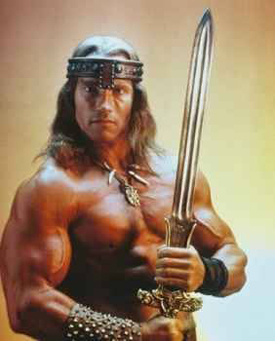

Conan the Barbarian (1982)
Arnold barely speaks as the pulp fantasy hero, but he IS Conan, brooding in every scene, hacking through bad guys, and bedding several beautiful women. And that’s basically the whole movie (there is some plot to speak of, but it quickly gets too convoluted to follow). This is one of those trashy B-fantasy films that they don’t make anymore (which may or may not be a good thing). It can’t compete with modern fantasy epics like Game of Thrones or Lord of the Rings, but it can still pass the time, though its two-hour length is pushing it.


Last Action Hero (1993)
Young moviegoer Austin O’Brien is given a magic ticket and gets transported into the latest movie featuring supercop Jack Slater (Schwarzenegger, playing a character in a movie within a movie). It’s a clever premise, with some funny pop culture references and interesting ideas about how characters in an action flick must live their life in the fictional world of the movies. But when Slater and his nemesis escape into the real world, things get pretty ridiculous (culminating in the real world Arnold coming face-to-face with the character he plays). It’s also too bad that the film went for a cutesier, family-friendly PG-13; an R-rated action tribute/satire could have been so much funnier. It does have its moments, though.

Batman and Robin (1997)
This is the infamous film that killed the Batman franchise until Christopher Nolan revived it, and yes, it is as bad as its reputation. Forget staying true to the comics; there are so many random, illogical, and just plain dumb sequences and plot holes that it barely works as just a movie in and of itself. Everyone onscreen seems to know that they’re in little more than a long toy commercial, but while most of the cast just seems to be going through the motions (George Clooney looks like he’s waiting for his check so he can get back to ER), Arnold at least tries to have fun with his role as Mr. Freeze, hamming it up and dropping the one-liners. For anyone who’s still watching after 20 minutes, the picture is high comedy.

End of Days (1999)
Playing off the fears of Y2K, this horror/action fest has Arnold as a burnt out cop taking on the Devil himself, who has taken over the body of a Wall Street trader (Gabriel Byrne) in hopes of fathering the Antichrist before the turn of the millennium. It’s every bit as awful and ridiculous as it sounds  And yet, it is entirely watchable, if only for the goofy bad action movie tone that (rather humorously) undermines such dark subject matter (plus, Breaking Bad fans can spot Tio Salamanca as the Pope). Arnold’s scene with Satan—where he berates the Prince of Darkness as “a choir boy”—was alone worth the price of a ticket in the pre-YouTube era.
 

Welcome back, Arnold!

Friday, July 27, 2012

One Week Later: The Dark Knight Rises

I was going to write this review on July 20, the day The Dark Knight Rises opened.  I had been preparing myself for weeks for this movie, rereading my collection of Batman comics and watching the previous films in the series over again, and went to a midnight showing with some friends at our local movie theater.  But as we were having a great night out at the movies, people at such a midnight screening in Aurora, Colorado, were being wounded or killed by a mad gunman.

Upon hearing the news of the shooting the next morning, my enthusiasm for the movie (and reviewing it) dissipated.  I had been so eagerly awaiting it for over a year, and I had almost forgotten about it less than 24 hours after seeing it.  In the face of real life tragedy, a simple movie, even arguably the biggest movie of the past few years, seemed kind of trivial.

In the week since the shooting, as the news cycle went from grief and sorrow back to election year politics, I went to see the film again.  That’s a luxury not usually afforded to a reviewer, but I felt in this case it was necessary.  People have tried to blame tragedy on pop culture before (some blamed the Columbine shootings on the video game Doom and rocker Marilyn Manson), but this was different: this time, the shooter actually identified himself as “the Joker,” the famous Batman villain, and had rigged his residence with explosives, almost as if he was really trying to play the role of supervillain.  Knowing all this, is it possible to view The Dark Knight Rises untainted by this event?

Like Heath Ledger’s death before the release of The Dark Knight, this tragedy will sadly always be connected with the movie.  But also like The Dark Knight, it is possible to view the film on its own merit, unaffected by events of the outside world.

So, a week late, here is the big, epic review I had planned to write.  And yes, there are spoilers throughout, so don’t read any more if you haven’t seen the film.


When I first saw Christopher Nolan’s Batman Begins in 2005, I was surprised to see such a strong dramatic film based on a comic book character.  My expectations were higher for 2008’s The Dark Knight, but Nolan blew them away again, as the film was a dark, masterful piece of work, every bit as great as the best film noir or crime dramas ever made.  So my expectations for The Dark Knight Rises had escalated to as high a level of excitement as I ever felt for a movie.  And I wasn’t alone: If you’re reading this, I’m guessing you already know that this has been the most hyped film of the new decade. 

To his credit, Nolan does his level best to fulfill those expectations, throwing everything and a nuclear warhead (literally) into his final chapter.  There are more characters, more and new vehicles, bigger action sequences, a cast of thousands, and a running time close to three hours.

It certainly is bigger, darker, and grimmer, but does it live up to the hype?  Well, not quite.  For all its epic size and scope, it falls short of the standard for superhero pictures set by The Dark Knight.  But it is still a very good film.  Even if it doesn’t live up to the level of expectation it had (and really, anything less than the greatest movie ever would fail to do so), it still reaches great heights as a work of cinema.

As this is the finale, the story skips ahead to eight years after The Dark Knight.  Batman (Christian Bale) has not been seen in that span, and his alter ego Bruce Wayne is now a broken-down recluse who walks with a cane.  In his absence, Gotham City has gone from a crime-ridden hellhole to a model city.  Wayne is forced to don the cowl again, however, when the masked mercenary Bane (Tom Hardy) appears in Gotham.

Bane’s plan is to break the Bat and take over the city.  He does just that, giving the Dark Knight the most brutal beating he’s ever gotten onscreen, and the film splits into two stories.  One has Wayne out of action (and out of costume) for much of the movie, as he is held captive in an ancient prison pit.  With Gotham facing destruction, he must regain his strength by climbing out of the pit.

Yes, the title The Dark Knight Rises is a literal statement of the direction of the film (The Dark Knight Climbs doesn’t quite have the same ring to it).  It’s a little lame, and also hard to swallow that he could suddenly be healed and able to take Bane after simply climbing out of a hole, especially after the beating he receives earlier in the movie.  Also, the big, epic fight between the two disappointingly never happens; their rematch later in the movie is just a small part of a much bigger finale.  Instead, Bane meets his end in rather anticlimactic fashion.

The more compelling story takes place in Gotham, where Bane cuts off the outside world by destroying all the bridges, holds the city hostage with a nuclear bomb, and frees all criminals from prison to prey on the police and the rich and powerful.  Here, the tone of the film turns to that of a brutal urban war movie (there is little blood, but the violence pushes the limit of the PG-13 rating).  It ‘s also here that, in Batman’s absence, Commissioner Gordon (Gary Oldman) and Gotham cop John Blake (Joseph Gordon-Levitt) become the real heroes of the picture (more on them later).  The only flaw is that the storyline seems a little rushed, as a considerable length of time (five months according to the dialogue) passes in only about an hour of screen time.

Indeed, that’s the picture’s main weakness, packing in enough plot points to stretch the film into a miniseries (not a surprise, as two comic arcs Nolan cited as inspiration, Knightfall and No Man’s Land, were huge inter-title crossovers that each lasted more than a year).  In addition to what I mentioned already, there’s Wayne’s financial troubles, the love triangle between Bale, Anne Hathaway, and Marion Cotillard, the tying of nearly every loose end from the first two movies, and the creation of more loose ends for potential sequels.

Third entries in other superhero franchises like X-Men: The Last Stand and Spider-Man 3 made the same mistake, squeezing too much into one film.  The Dark Knight Rises is likewise top-heavy, but unlike those movies, it never falls and breaks under its own weight.  Some plot points may be fleeting, but the film is never boring in its 165 minutes, as there is always something happening (one thing about Christopher Nolan: his movies never seem to have a slow scene).

Tom Hardy has an imposing physical presence as Bane, although his much talked-about vocal problems still linger (first Batman’s grating growl and now this; seriously, why does this series have problems with voices?).  Between a bad accent and being garbled by the mask, he's hard to understand at times, undercutting his menace a bit (I was reminded, of all things, of Kenneth Mars in Young Frankenstein, and imagined Bane’s henchmen saying “What?” in unison after some of his monologues).  His fists usually do the talking, however, and he makes for an effective foe, if not on the same level of Heath Ledger’s Joker (though following such a performance is a tall order).

Even better is Anne Hathaway as Selina Kyle (better known as Catwoman, though she is never referred to as such onscreen).  She—in the words of another Catwoman—purrrrrrr-fectly captures the character’s cunning, sex appeal, and moral ambiguity, not truly evil but not quite good.  The only downside is that she seems a bit like just a cog in a much bigger machine (so do other characters at times).  It’s too bad this is the series’ final chapter, because the character deserves another movie, one where she is not overshadowed by a villain like Bane (though the open-ended epilogue and talk of a spin-off film suggest we haven’t seen the last of her).

Christian Bale does well enough, despite being mired in the less interesting plot (and it’s hard to buy that he’s decrepit when he looks barely older or worse for wear than in The Dark Knight).  Series regulars like Michael Caine as Wayne’s loyal butler Alfred and Morgan Freeman as Lucius Fox are strong as ever, as are newcomers like Marion Cotillard as Bruce Wayne’s colleague and lover (and eventual betrayer) and Matthew Modine as Gordon’s opportunistic second-in-command who nevertheless shows courage and character in the end (another notable element of Nolan’s work: even in minor roles, he casts good actors).  

As stated, however, the two greatest people in the movie are Gary Oldman and Joseph Gordon-Levitt.  With the exception of Heath Ledger, Oldman, one of the most underrated great actors, has been the best performer in the series.  As Jim Gordon, he took what was a minor role in all other adaptations and made him into a fully-rounded character, a voice of courage and moral authority and the Bat’s greatest ally.  I’ll even contend that his role over the three films warrants an Oscar for Best Supporting Actor.  As for Gordon-Levitt, he arguably upstages Batman as the more compelling leading man (and judging by the film’s ending, I’d say Nolan agrees that he plays the hero well).  Already a proven actor in smaller films, this could be the picture that puts him on Hollywood’s A-list, much like what Batman Begins did for Bale.

Because of the story flaws (and the letdown of no big Batman-Bane fight), The Dark Knight Rises might be the weakest of the trilogy, but it’s so well made and endlessly, relentlessly thrilling that it closes the series on a more-than-satisfying note.  With this picture, Nolan caps off what has easily been the greatest superhero franchise ever filmed.  Moreover, what he’s meant for movies based on comics cannot be understated.  What he did was so simple, yet so revolutionary: he took the material seriously.

If it weren’t for Nolan’s Batman, movies like Iron Man and The Avengers might have still been made, but would they have been made so well, with real actors instead of just current big stars?  I don’t know.  Would Spider-Man have gotten a much better reboot so soon after a series that was already very successful?  Maybe not.  Would something as deep and thoughtful as Alan Moore’s Watchmen have gotten such a faithful adaptation?  I doubt it.

When Batman Begins came out, it didn’t even cross my mind that it would be anything but your typical fun, flashy summer superhero flick (remember, the awful Halle Berry Catwoman was released just a year before).  Seven years later, I—and I’ll venture to say most audiences, too—expect quality films, not just from Batman, but all comic book adaptations.  And for the most part, studios have strived to deliver on those expectations.  That, more than any one film, is Nolan’s greatest legacy.

Worth seeing in IMAX? Definitely!